by Philip Robinson
Some of you may have noticed an article by Esther Addley in The Guardian last week (23/07/2025). In it, Esther reported on an archaeological project undertaken by Ben Saunders of Wessex Archaeology. This was analysis of a piece of timber discovered on Sand o’Erraby beach on the island of Sanday, one of the Orkney Isles.
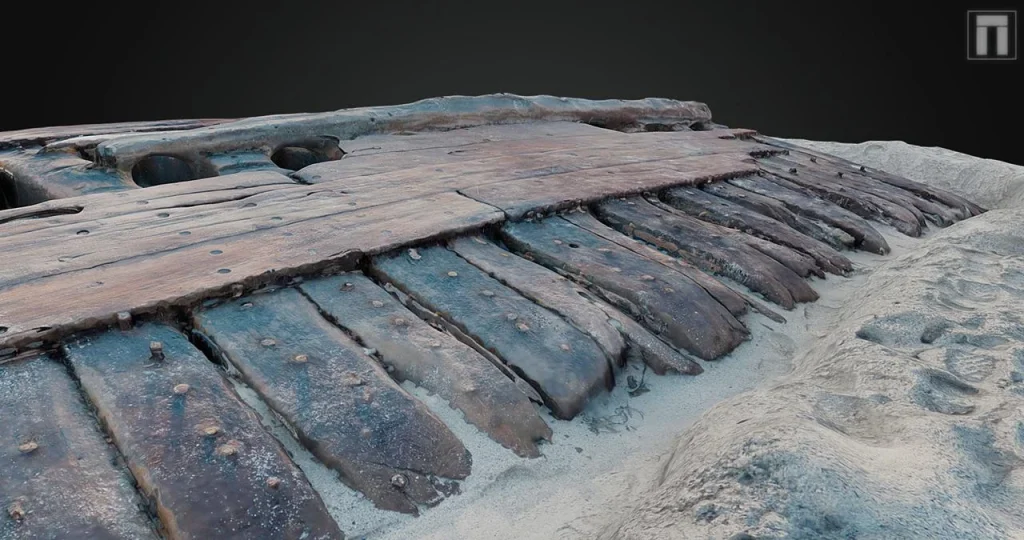
The timber is now known to be part of HMS Hind, a 24-gun Royal Naval frigate, one of at least 270 vessels known to have foundered off Sanday. What particularly struck my eye was that she was built by Chitty and Vernon in Chichester, or more specifically Itchenor.
I am grateful to Dr. Ian Friel for the following information.
Richard Chitty was a carpenter and timber merchant from Singleton. He had been supplying the navy with timber since at least 1730, using timber stocks from around Singleton, and later Midhurst and Petworth. He was evidently a fairly wealthy individual who knew how to ingratiate himself with the Navy Board, the body charged with building and maintaining the fleet. Ian illustrates this through an 82-word letter Chitty wrote in 1747 in which the word ‘humbly’ recurs three times and the letter signed ‘your most obedient humble servant, Richard Chitty’.
In the eighteenth century there were constant worries that the country was running out of oak for shipbuilding though Richard Chitty managed to procure and supply oak from as far away as South Wales. Richard Chitty died in 1770 and was buried on Wednesday 11 April at St. Mary’s Church, Singleton. By this time, he had properties in West Sussex and Surrey.
Nothing is known about Vernon though Ian Friel speculates that Chitty was the business brain and Vernon was the master shipwright. Their yard was probably to the west of the present Haines’ boatyard in Itchenor.